
Minnetonka Wood Flooring has built, refinished and converted hardwood stairs for more than 20 years, working on staircases in houses, townhomes and lower levels across Minnetonka, MN. We refinish worn treads, replace damaged treads and risers, and convert carpeted stairs to hardwood that matches the floor beside them.
Every stair is quoted per tread and riser rather than folded into a square-foot price. Stairs take far more hand work than open floor, and listing them separately lets you see exactly what the staircase costs on its own.
On the quote, we also note the finish, the number of coats, the dry time between coats and how you will get up and down while the work is underway, since in most houses the stair cannot simply be closed for a week.
The Parts of a Hardwood Stair
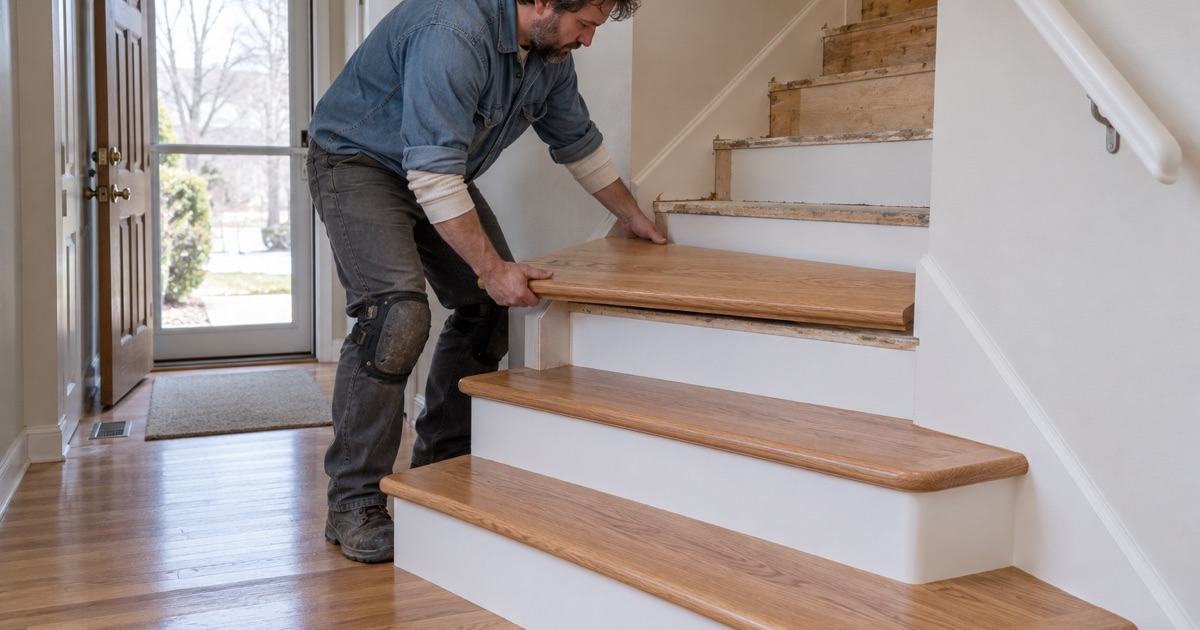
Treads, Risers and Nosing
The tread is the horizontal surface you step on, and the riser is the vertical board between treads. The nosing is the rounded front edge of the tread that projects past the riser. Each part wears differently, with the nosing and the center of each tread taking most of the traffic.
When we inspect a stair, we check each tread for cracks, looseness and wear, each nosing for damage, and the risers for scuffs and gaps. That tells us which parts can be refinished and which need replacement.
Stringers, Skirt Boards and Landings
The stringers are the structural supports that carry the treads. A skirt board often runs along the wall side of the stair. Landings connect flights of stairs and are usually floored like the rooms around them, with a landing tread or nosing at the edge.
When a tread squeaks or moves, the cause is often a loose connection between the tread and the stringer. We secure those connections before refinishing so the stair is quiet and solid.
Matching the Stair to the Floor
A staircase looks best when its treads, nosing and landing match the adjoining floor in species, color and sheen. We match species first, then stain and finish the stair alongside the floor when possible, so the color carries from the hallway onto the stair without a break.
Converting Carpeted Stairs to Hardwood
What Is Under the Carpet
Many stairs built to be carpeted have plywood or construction-grade treads that were never meant to be seen. Older stairs sometimes have finished hardwood treads underneath that can be refinished. We lift a corner of the carpet before quoting so we know which you have.
Removing the carpet also means pulling tack strips, staples and padding, filling the holes they leave, and dealing with a nosing that may have been cut back to fit the carpet.
Cap Treads Versus Full Replacement
If the existing treads are structurally sound but not finish quality, we can install new hardwood treads over them or replace them entirely. Full replacement gives the cleanest result and the correct stair geometry. Overlaying treads adds height to each step, so we check that rise heights stay consistent from top to bottom.
The top and bottom steps need the most attention. Where the stair meets a new hardwood floor, the landing tread or nosing has to sit at the right height, and at the bottom, the first rise has to account for the finished floor height, so no step ends up noticeably taller or shorter than the rest.
New Risers and Skirt Details
Risers are often painted white for contrast or finished to match the treads. New risers can be installed over old ones or replace them. We finish the area where the tread meets the skirt board and wall cleanly, since gaps there are easy to see on a bare stair.
In pre-1978 houses, painted risers, skirt boards and stringers may contain lead paint. When stair work disturbs those surfaces, we follow the federal lead-safe work rule, sealing the area and cleaning with HEPA vacuums, and we describe that containment by the equipment used.
Refinishing Existing Hardwood Stairs
Hand Sanding Each Tread
A drum sander cannot reach stair treads, so every tread is sanded with smaller tools: an orbital sander for the flat surface and detail sanders and scrapers for the edges, corners and nosing. This work takes much longer per square foot than open floor, which is why stairs are priced by the step.
Worn nosing is the hardest part to restore. Years of foot traffic round and thin the front edge, and sanding it back to clean wood can leave it uneven from step to step. When a nosing is badly worn or cracked, replacing it gives a sharper, safer edge than trying to sand it out.
Staining and Finishing
After sanding, we stain the treads if you have chosen a color, then apply finish coats. Waterborne polyurethane dries quickly, which helps when the stair has to stay in use. We choose a sheen that balances appearance with traction, since glossy treads can feel more slippery.
Working Around a Stair You Need to Use
In many homes, the stair is the only way to the bedrooms. We can finish alternate treads so you can step on every other one, or finish the stair in stages around the household schedule. The dry time and when the stair can be used normally are written on the quote.
Safety and Comfort on Hardwood Stairs
Loose Treads and Squeaks
A loose tread is a safety hazard, not just a noise. We secure loose treads to the stringers with screws and adhesive from below where accessible, or from above with plugged fasteners where the underside is finished.
Handrails and Balusters
Floor work often happens around the handrail and balusters. We protect them during sanding and finishing, and we make sure the new treads fit tightly around baluster bases. When balusters need to be removed for tread replacement, we reinstall them securely.
Traction and Runners
Bare hardwood stairs can be slippery in socks. A lower sheen finish improves traction, and a runner adds grip and reduces noise. If you plan to add a runner later, we can finish the treads with that in mind so the exposed edges look right.
- 20+ Years on Wood Floors
- Per-Square-Foot Written Quotes
- Stairs Priced Per Tread